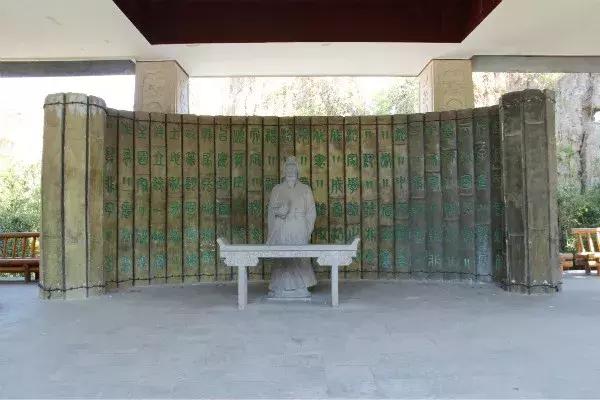
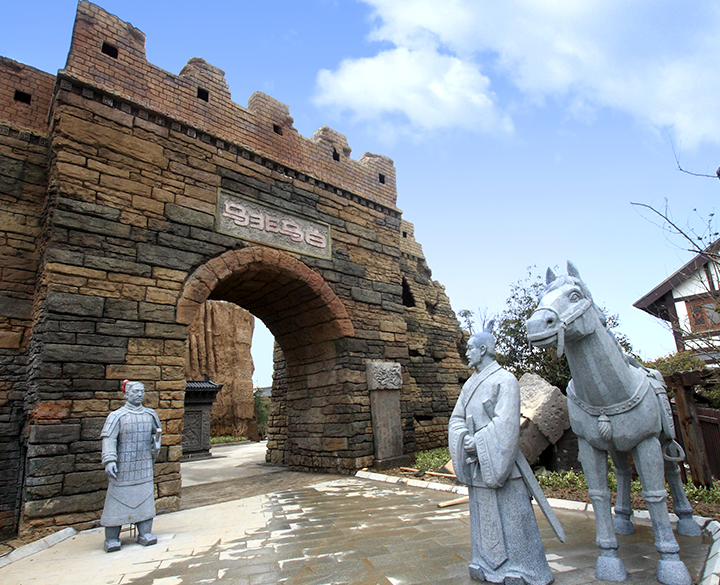
During the Spring and Autumn and Warring States Periods, wars erupted from time to time. Its typical figures were Sun Wu and Sima Rangju in the former period as well as others in the later period like Wu Qi and Sun Bin. In particular, Sun Wu has been respected as the “Forefather of Military Arts” and the “Sage of Military Affairs”. The Art of War, his magnum opus, was the oldest book in this regard. Thanks to its far-flung impact, the monograph has been reputed as the “Classic of Military Thought”.
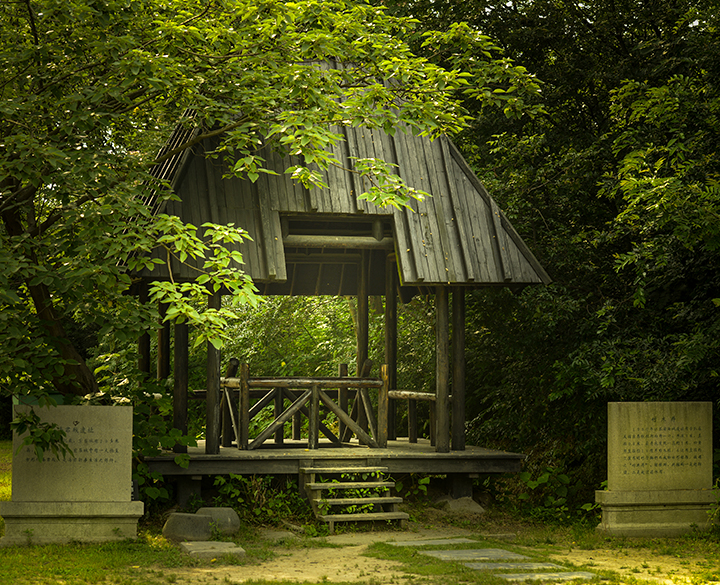
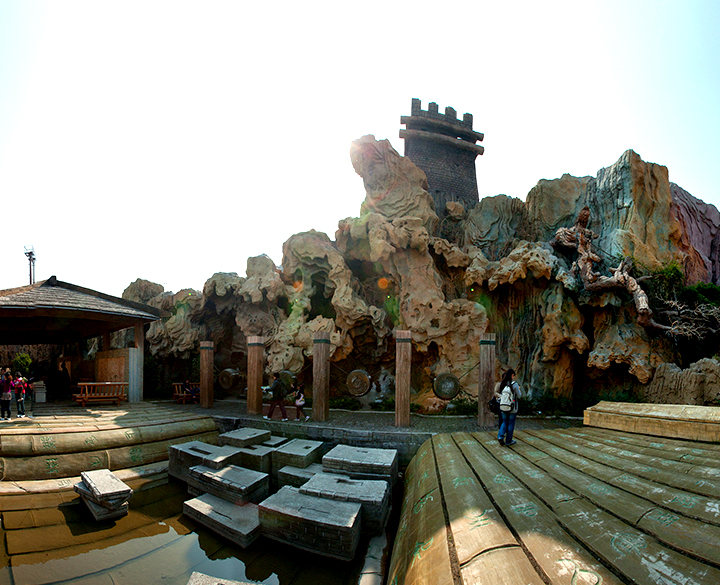
Bamboo Well is located in the Imperial City of Yancheng, with a history of about 3,000 years. The well is about 7 meters deep with square wellhead. Four corners of well are fixed with logs with a diameter of 10 cm. Thin bamboo is woven around the well wall to strengthen the well wall and filter the well water.
Such unique well is called “Bamboo Well”, as one of the early water well styles in China, mostly found in southern plain. Archaeologists found a pottery pot at the bottom of the well testified to be a tool used for fetching water, which proved that humans have settled here for a long time.
Confucianism pervaded more 2,000 years of feudal China. Since Emperor Wu of Han prioritized Confucianism before all others, the school represented by Confucius, Mencius and Xunzi had gradually become the mainstream thought permeating traditional Chinese culture.
Confucius, the founder of Confucianism, claimed a state shall be governed through ritual and virtue. He initiated private education, thus being reputed as the forerunner of plebeian education. History records “The Confucian master has 3,000 disciples, including 72 sages”. The Analects of Confucius has venerated as one of classics of Chinese thought and culture.
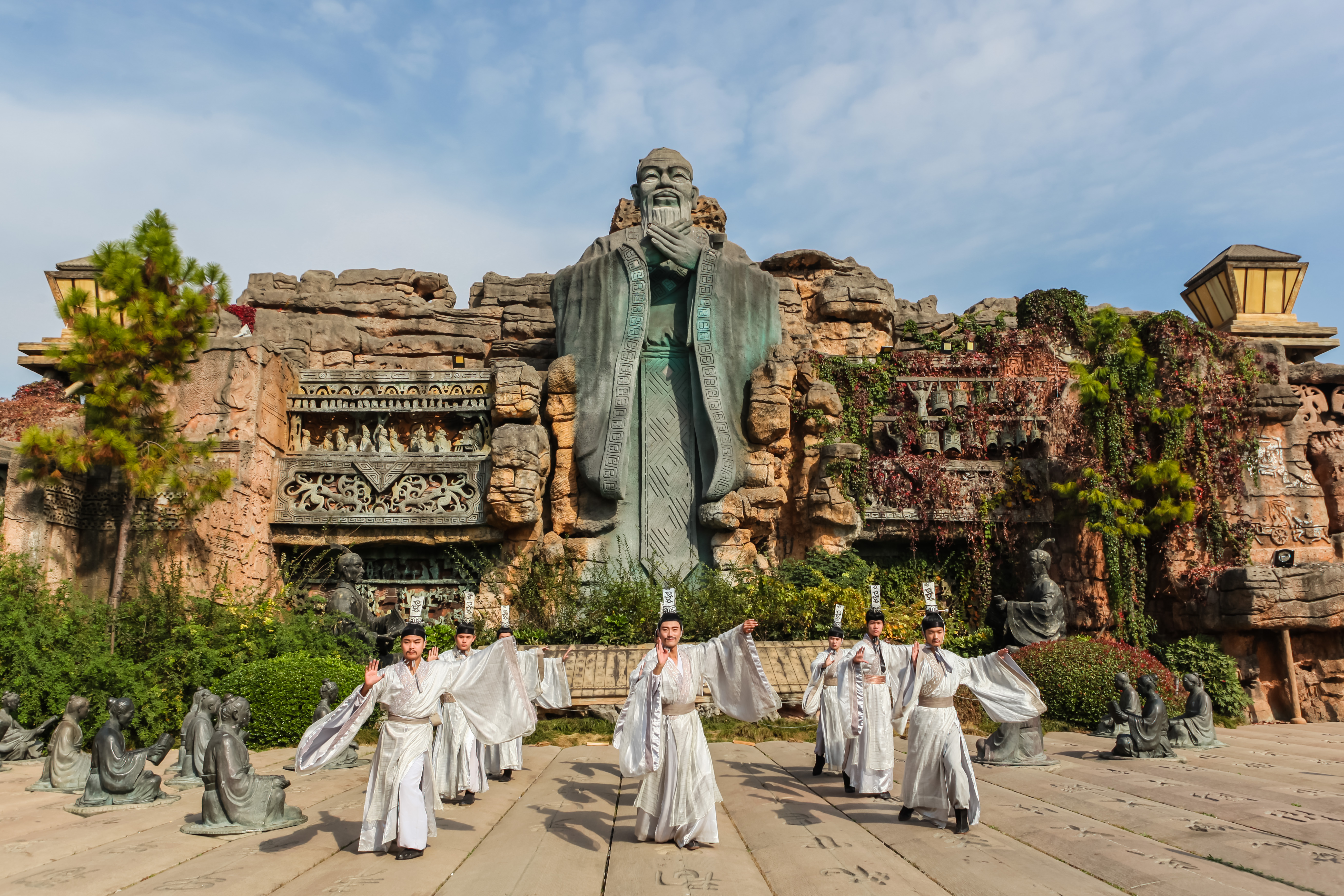
The statue of Confucius standing on the slope is 17 meters’ tall. The master, leaning forward with both hands clasped together, appears an amiable old man indeed. This image embodies Confucianism’s five virtues: moderation, kindness, respectfulness, frugalness and modesty. The stone inscription on the hill surface tells us what Confucius had undergone through his lifetime. Below this master are located statues of two junior sages—Mencius and Xunzi.
Typical Legalist Hanfeizi argued the state shall be ruled through stern punishment and strict legislation. Hanfeizi, vintage work of the thinker, has influenced ancient and modern China. This school created a profound impact on Chinese history.
“Minor-Talk” originated from Zhuangzi. As said in “Records of Literature and Art”, The Book of Han Dynasty, “The school of minor talks is derived from minor officials who loved talking about anecdotes. It is about gossips, chats and suchlike.” Such minor officials mainly took charge of recording what the plebs talked about, namely legends. Yu Chu in Western Han Epoch was known as one of paragons of this school. Yu created An Anthology of Stories on Zhou Era, the first collection of stories ever in ancient China.
What followers of this school talk is the name and essence of things, rights and wrongs of cases. In fact, it was the school of logic in ancient times, which boasts typical figures like Gongsun Long, Deng Xi and Hui Shi. Such logicians were famous for being expert at analyzing the “name” and the “essence”. Up till now, their classic dogmas like “White Horse Is not a Horse at All” have been still alive.