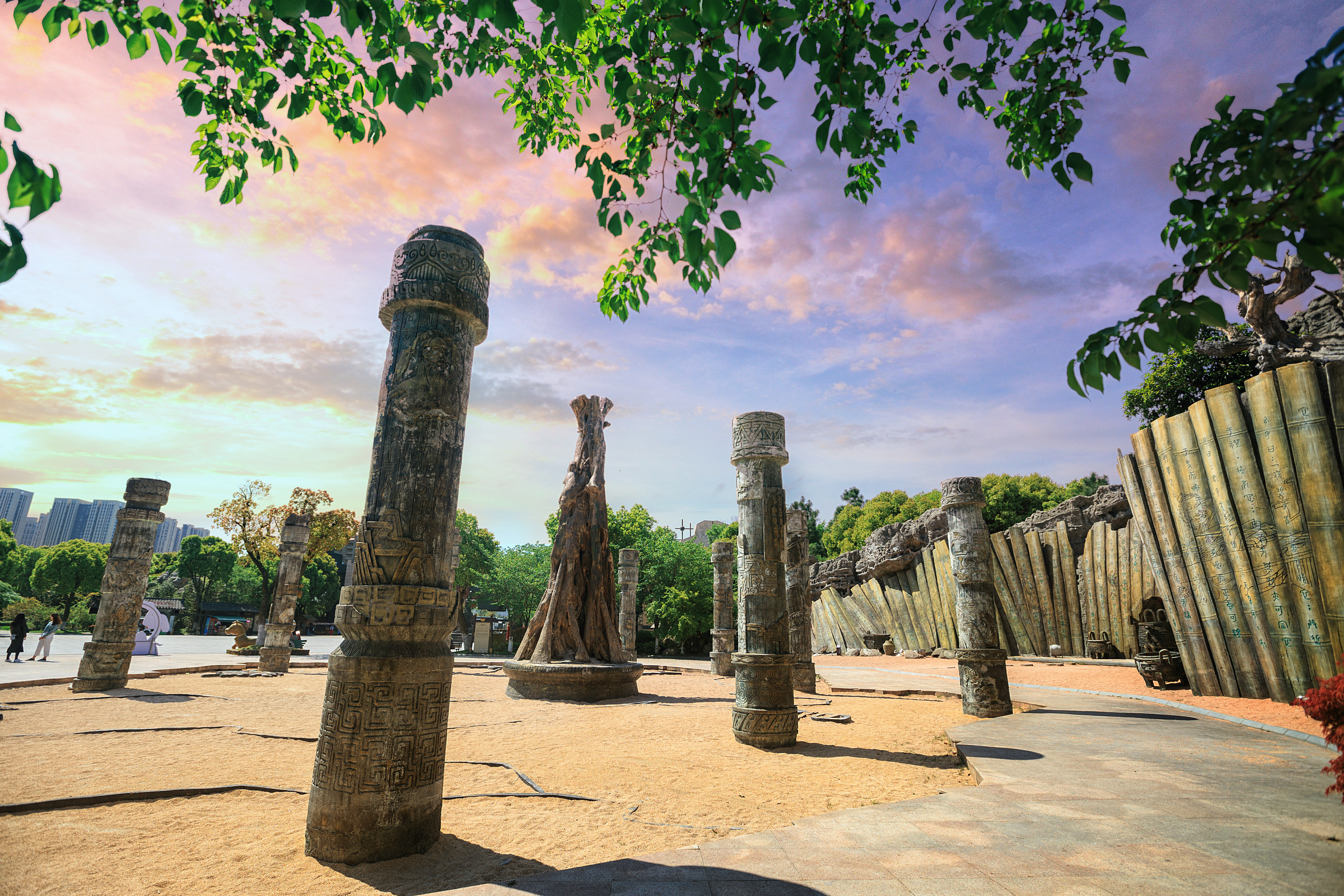
面前的这十二根柱子叫图腾柱,分别代表了儒家、道家等十二大家。版图中心这棵苍劲的古木,显示了诸子百家学术繁荣的景象。
中国汉字起源于图画,最早是象形文字。创始人是上古皇帝时代的史官仓颉。3000多年来,由殷商的甲骨文,经历了大篆、小篆、隶书、楷书、草书、行书等形态演变。春秋文字是大篆体,所以园内的文字大多是用篆体书写的。此处半壁书简上的文字也以篆体为主。
面前的这十二根柱子叫图腾柱,分别代表了儒家、道家等十二大家。版图中心这棵苍劲的古木,显示了诸子百家学术繁荣的景象。
中国汉字起源于图画,最早是象形文字。创始人是上古皇帝时代的史官仓颉。3000多年来,由殷商的甲骨文,经历了大篆、小篆、隶书、楷书、草书、行书等形态演变。春秋文字是大篆体,所以园内的文字大多是用篆体书写的。此处半壁书简上的文字也以篆体为主。
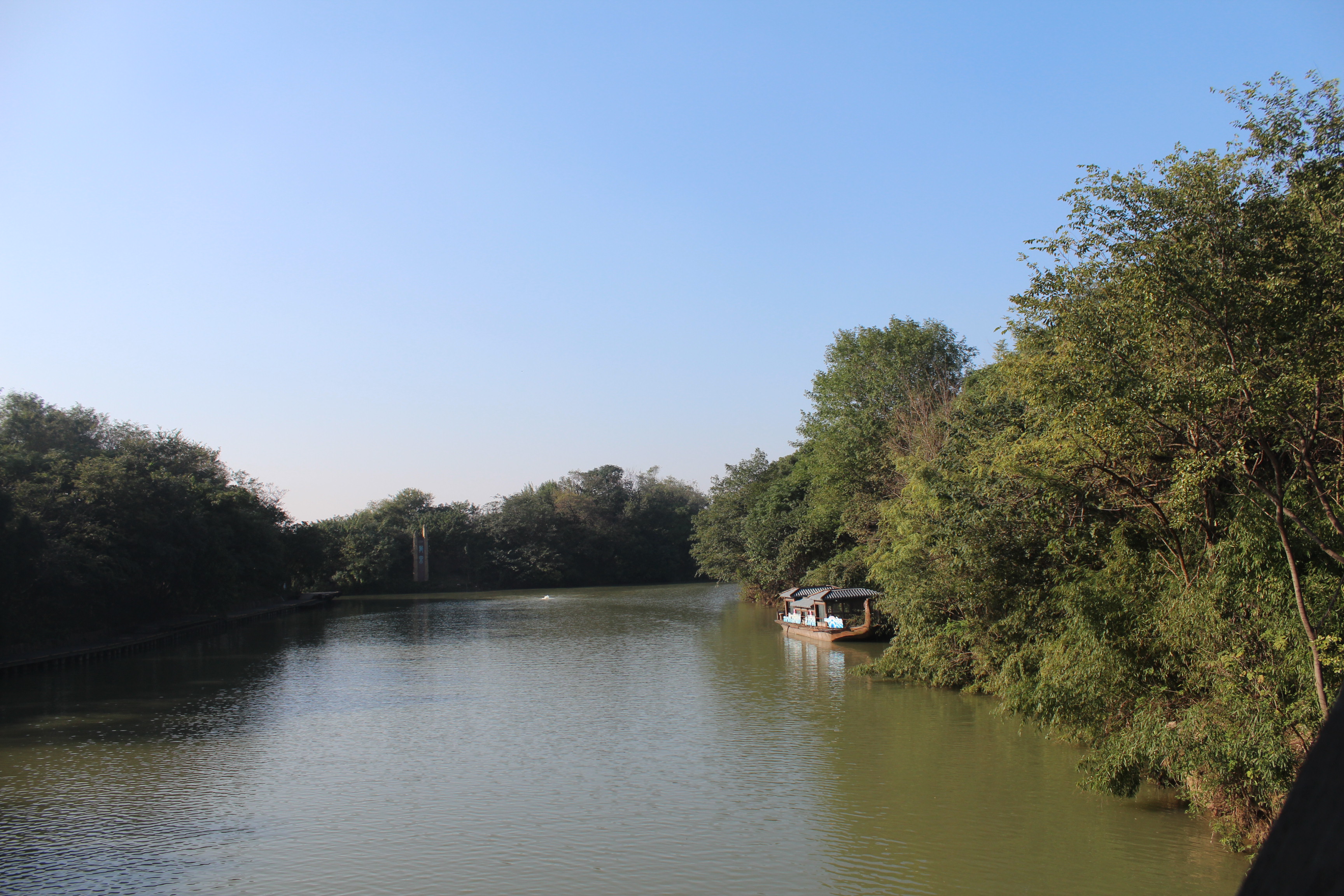
Yancheng takes on a unique look because it falls into three circles from inside to outside: imperial city and its moat; inner city and its moat; outer city and its moat. Now we stand outside the outer city. Cross the moat bridge at the outer city and we will come into this antique scenic area.
The outmost moat is the first of its kind we meet here. Hi, please look along your right hands—the high portion inside this moat is called “the outer city’s outer wall” and the left “its inner wall”.
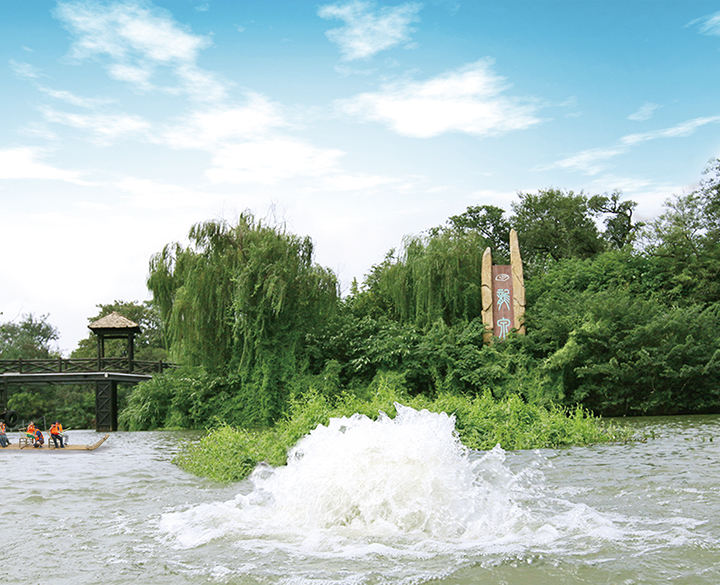
远处有水花冒出的地方叫龙泉,也被称为龙潭。在水面下方有一深潭,当地村民曾用十几米长的竹篙探底,却毫无见底迹象。1934年江南大旱,常武地区百条河道干涸,千亩田地龟裂,但唯独这龙泉之水清澈如常,源源不断。因此民间传说这里与东海龙宫相接,还流传着这样一首民谣:“龙泉之水东海来,万年不枯香甜美,滋润两岸万物生,全靠龙女白玉龟。”
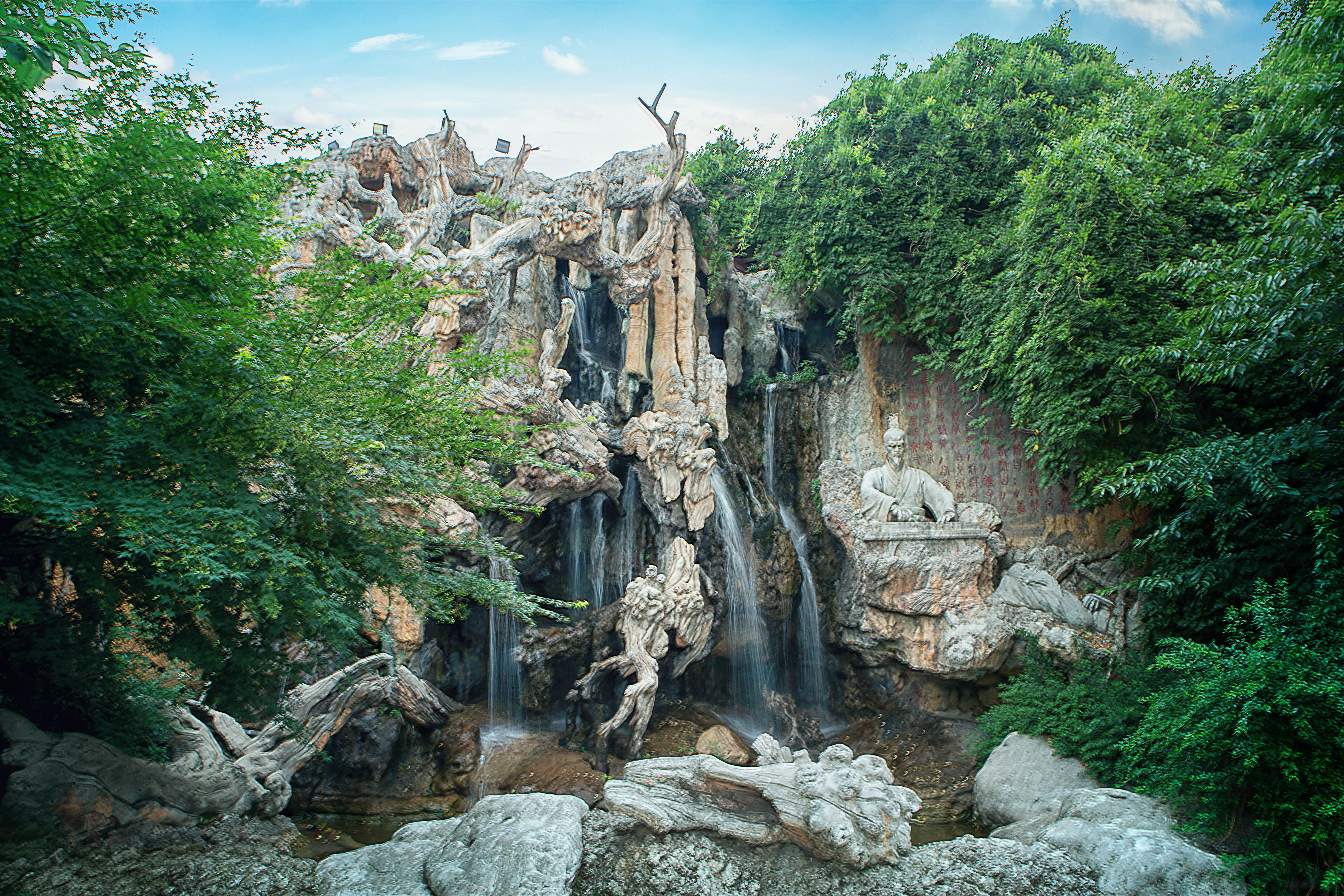
Since the Spring and Autumn Period, China’s most scholastic schools along with their leaders had taken form. Those great ones include Confucius the forefather of education, Lu Ban the founder of carpentry, Fan Li the earliest businessman and Paoding the forerunner of cooking. Moreover, thoughts of these schools have been transmitted through many brilliant idioms to this day.
“Stealing a Ring with Covered Ears”. Once upon a time, a silly thief wanted to steal a house’s door-ring. So, he tried to break the ring with a hammer, only to get himself caught by the owner on the spot. That damned fellow is the muddle-headed thief famous from old times to now.
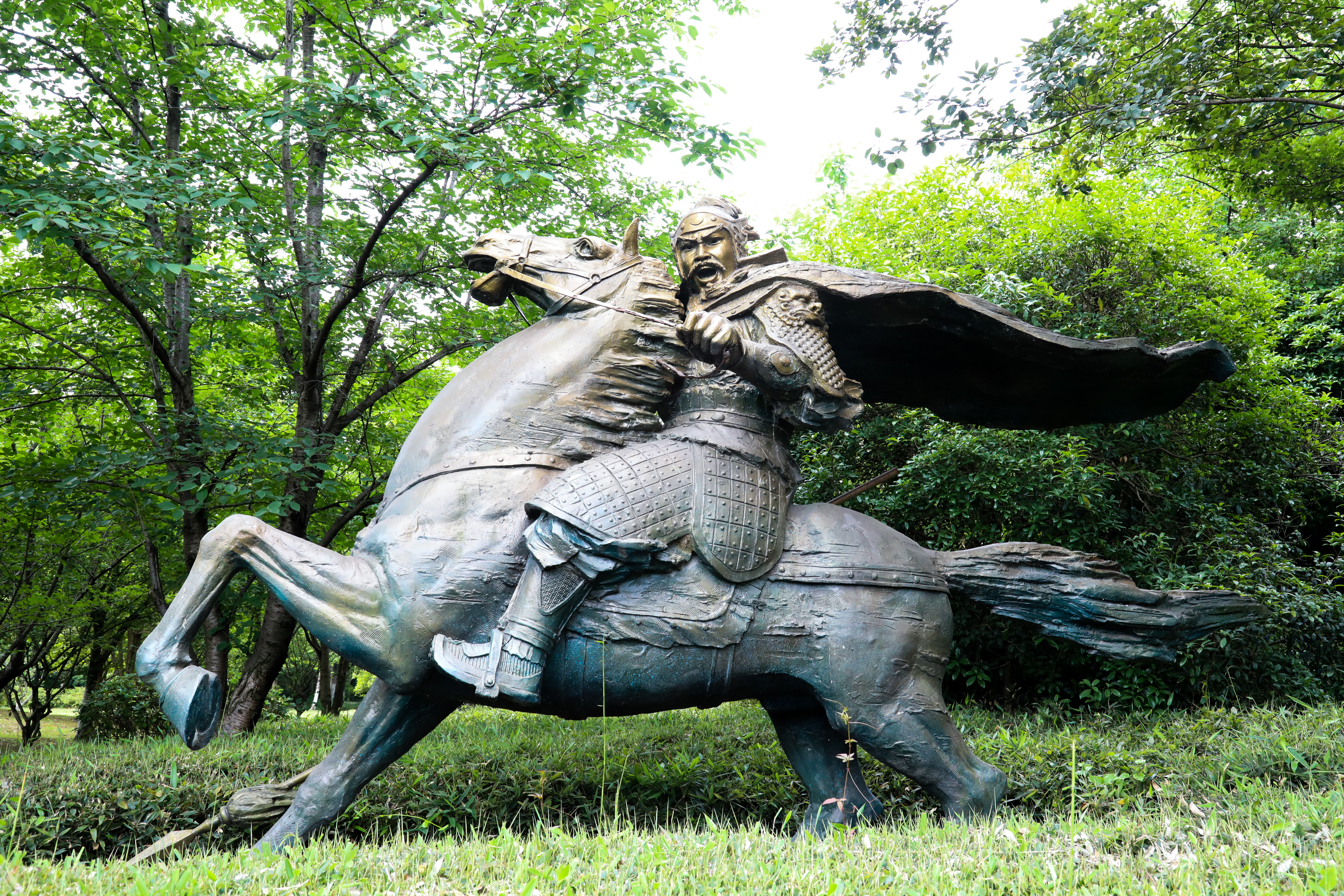
“A Pair of Soul Mates”. This tale tells us how Boya, a lute player in the Spring and Autumn Period, met with his soul mate. Later Feng Menglong, Ming Era’s storywriter, added Yu to Boya as a surname. Long time ago, Boya, Grand Master of Jin State, returned home by boat. When the boat got moored midway at the bank on the Mid-Autumn Night, Boya played his lute artfully amid the inviting scenery. All of a sudden, some fellow clapped his hands on the riverbank. That turned out a woodcutter called Zhong Ziqi, who made such loud noise unconsciously. The guy, attracted by the tuneful melody, told Boya candidly, there were lofty mountains and gurgling waters behind the melody. That ethereal realm went far beyond language. Hearing this remark made Boya overjoyed and thus thought the woodcutter was his unique soul mate. They made an appointment to meet again here. When Boya visited there once more, Zhong Ziqi had long passed away. So, Boya sadly threw his lute on the ground, breaking it into tiny pieces. The great musician had never played his lute since then. This sculpture brings alive a harmonious scene, in which Boya plays his lute heartily and Zhong Ziqi listens with his head leaning on one arm. Lute and mind blends into each other so as to create the so-called communion between this pair of mates.
“Making the Number”. This alludes to King Xuan of Qi State, a mad aficionado of Yu the ancient instrument. The king had 300 musicians at hand. One Mr Nanguo, knowing nothing about the instrument, joined the awesome band as if he were expert at playing it. During the playing process, he often shook his head like others. He behaved like that for three years. Later when King Xuan died, his son, Min King, loved solos instead. Consequently, Nanguo had no choice but to flee on that night with fright. He is the famous Nanguo in history. Just take a look—now he is still increasing the number here!
从春秋开始,中国大部分的学术流派逐渐形成,产生各行各业的领军人物。如教师的祖师爷孔子,木匠的祖师爷鲁班,商人的祖师爷范蠡,厨师的祖师爷庖丁等。另外各家各派的思想还以寓意深刻的成语形式流传至今。
“掩耳盗铃”说的是有一个笨贼,想要偷走别人家的门铃,就捂着自己的耳朵用锤子去把门铃敲碎,结果门铃大响,而被主人逮住了。门下这个人,就是那个出名几千年,自欺欺人的笨小偷。
“高山流水”讲述的是“伯牙鼓琴遇知音”的故事。伯牙姓伯名牙,明代小说家冯梦龙在伯牙名字前,加了个“俞”字,被叫成了“俞伯牙”。春秋晋国大夫伯牙乘船返乡。八月十五船行到奔牛靠岸停泊,面对中秋美丽的夜色,伯牙迎窗弹琴。忽听岸上有人拍手叫好。岸上有个叫钟子期的樵夫,被优美的琴声吸引。并对伯牙说:琴声中隐含了高山流水的意境。伯牙听后欣喜若狂,认为终于遇到了知音。两人相约来年中秋再会。伯牙再来寻访时,钟子期已去世,伯牙因为痛失知音,摔碎了琴瑶,从此不再弹琴。这背靠山崖弹琴的是俞伯牙,一旁枕臂倾听的是钟子期。琴声与心声共鸣,才有心灵的沟通。
“滥竽充数”说的是齐宣王非常喜欢听吹竽合奏,他手下有300个吹竽的乐师。有个不会吹竽的南郭先生 ,混进了这三百人的乐队,捧着不出声的竽装模作样,摇头晃脑,蒙吃蒙喝三年多。齐宣王死,齐湣[mǐn]王即位,喜欢听独奏。这下,南郭先生混不下去了,只得连夜逃走。大家看,那一位就是大名鼎鼎的南郭先生,此刻,他还在神气活现滥竽充数呢。
The place with foaming water, not far from here, is Dragon Spring, also called Dragon Pool. The pristine pool is infinitely deep. Local villagers ever fathomed it with a pole as long as a dozen or so meters, but still failed to touch the bottom despite all their effort. As a drought descended upon Southern China in 1934, Changwu Area (Changzhou along with its Wujin District) suffered so much that myriad rivers went dry and 1,000 mu or more fields cracked open. Instead, the spring water here looked as crystal as usual, but even gurgled endlessly. So, legend says the pool must be connected with the Dragon Palace of the Eastern Sea. As a local ballad puts, “O Dragon Spring rises from the East Sea far away; it tastes sweet and fresh over so many centuries. Like a mother, the spring nourishes all creatures on both sides. All this is ascribed to the Dragon Maiden’s White Jade Turtle.”
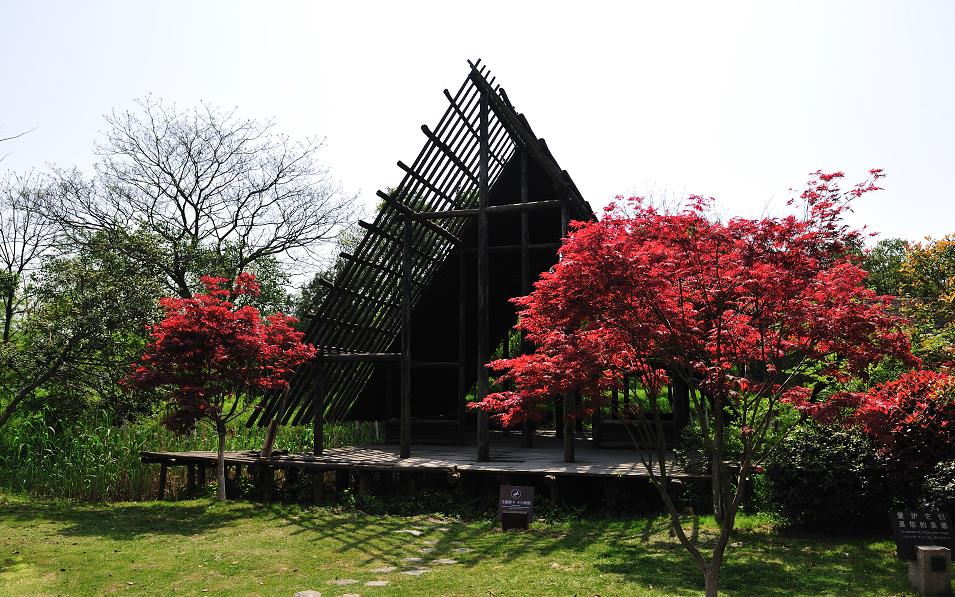
前方左手边大家看到的是一排仿古民居。它们主要仿照春秋时代的房屋外观建成,由于春秋时代的房屋以木架结构为主,加上南方雨水又多,长期下来木头容易腐烂,房屋很难被保存下来。因此,在淹城遗址内是不可能留下任何春秋时期的房屋建筑的,而留下的只有三城三河的城池结构和众多的出土文物。
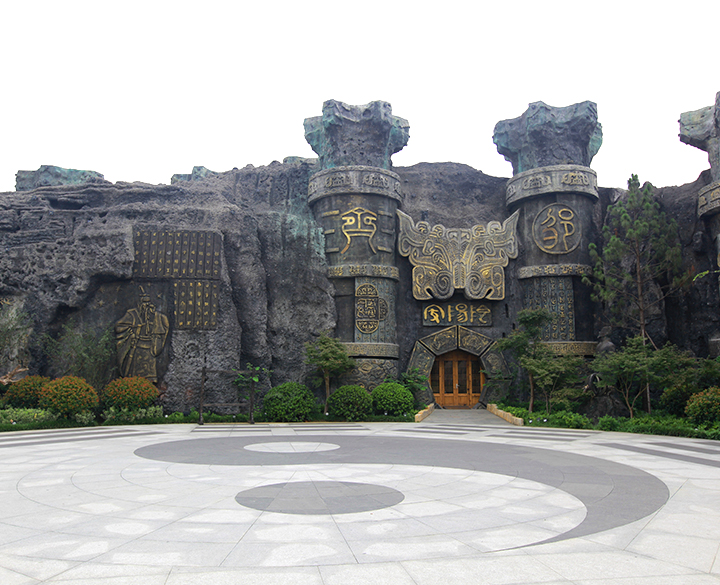
“Yin and Yang”, making their debut in I Ching, interpret the provenance of all things including the universe at large. The notion of “Five Phases”, consisting of Metal, Wood, Water, Fire and Earth, sprang into form in The Book of History. The two concepts had not begun to converge until the Warring States Period. This is the origin of Naturalists i.e. the School of Yin and Yang and Five Phases.
This scenic spot, set in a giant black aerolite, epitomizes what yin and yang really mean through Seven Stars of the Big Dipper, Eight Trigrams, etc. The man looking up the sky, in front of the rock, is Zou Yan, a native of Qi State, who is well-known as the best embodiment of Naturalism. Erudite as he was, the grandmaster expounded the cosmic evolution and rise and fall of dynasties applying the doctrine of Five Phases and Yin and Yang. So, he has been called “Yan Talking Celestial Phenomena” as a notable of Jixia Academy. This academy was the earliest institution of higher education and primordial science. According to some scholars, it appeared merely 20 years later than world-famous Plato’s Academy. Legend says, to promulgate his doctrines, Zou Yan toured various countries, being revered by all kings. When he arrived in Yan State in the north, the king in person swept the road for Zou Yan and took him as his own mater. Even sages like Confucius and Mencius had never enjoyed such honour. Obviously, his theory gained overwhelming prevalence during that period.
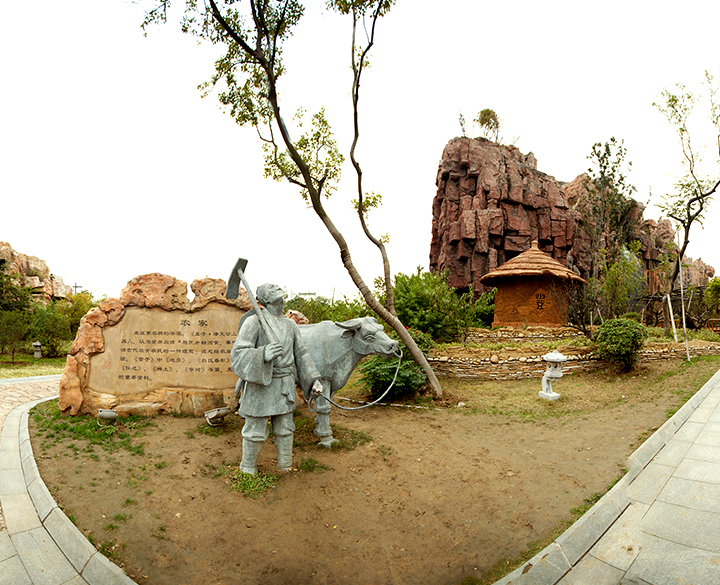
The best paragon of Agriculturalism was Xu Xing, who asserted himself as a descendant of Shennong. He studied hard agricultural technologies, but proposed the political idea that “lord and his people shall both farm the land”. That most shows his thought of equality between the ruling class and the populace.
Xu Xing leading his disciples worked hard at farming, so that “they’ve received good harvests of five grains, thus leading a well-off life”. Ancient China’s five grains refer to rice, glutinous millet, foxtail millet, wheat and soybean. Between Warring States Period and the Qin-Han Period, the Chinese mainly consumed five vegetables: sunflower, pulse-leaf, leek, scallion and garlic. Those plants mentioned by The Book of Odes amount to 132, including over 20 vegetables. As time went by, some species had faded out of the table.