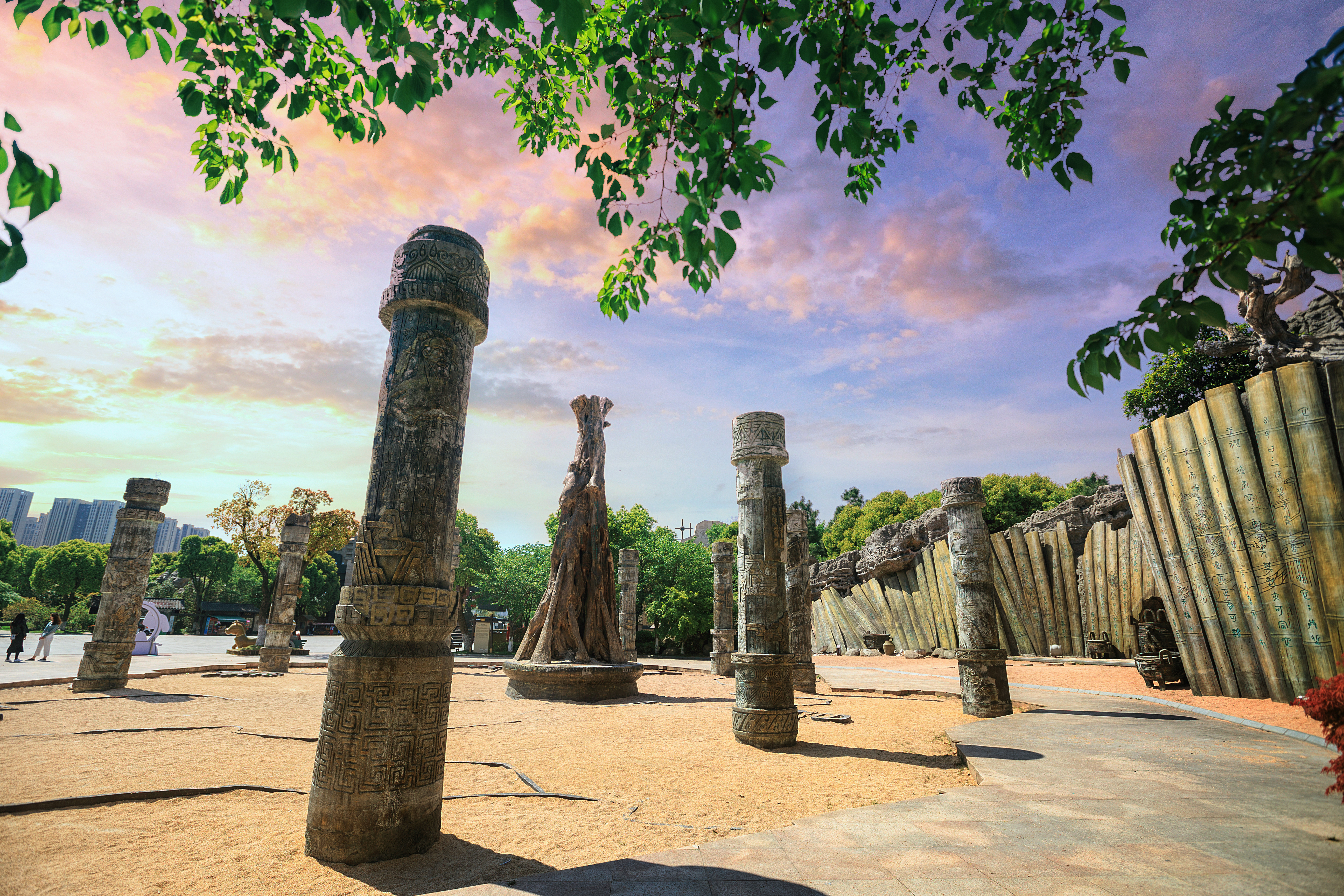
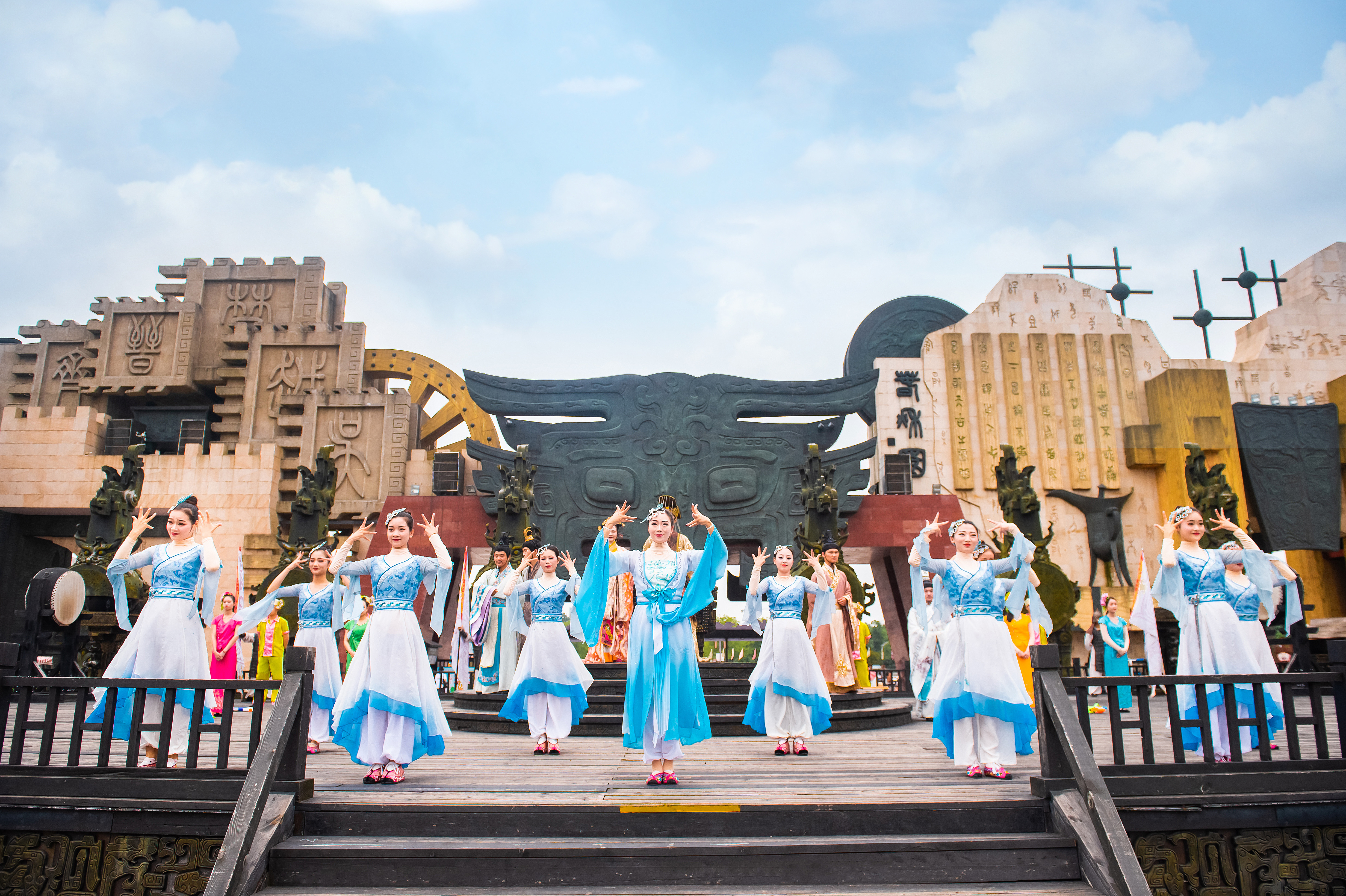
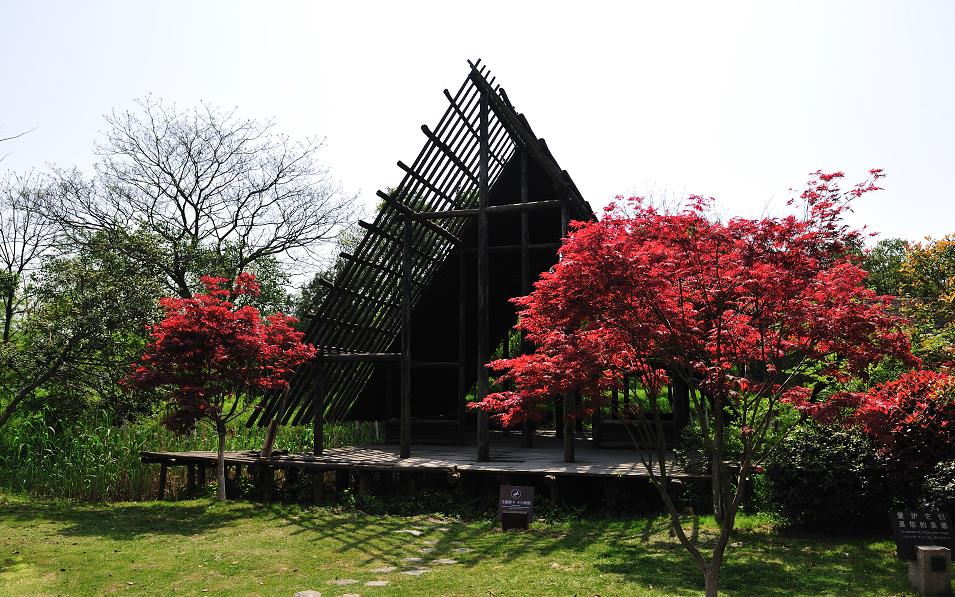
The poles ahead of us, in fact a sign of totem, represent 12 schools like Confucianism and Taoism. This vigorous old tree in the center of the domain best embodies the full bloom of the academia in that era.
Chinese characters, derived from pictograph, are an early hieroglyph indeed. Cang Jie, history scribe in the remote past, devised this long-standing writing system. For more than 3,000 years, Chinese writing regime has mainly undergone the several stages: greater seal script, smaller seal script, clerical script, regular script, cursive script and running script. Greater seal script dominated the Spring and Autumn Epoch. For this reason, most garden-wide writings, including those on the bamboo-slips of the half-wall are engraved in that script.
Yancheng takes on a unique look because it falls into three circles from inside to outside: imperial city and its moat; inner city and its moat; outer city and its moat. Now we stand outside the outer city. Cross the moat bridge at the outer city and we will come into this antique scenic area.
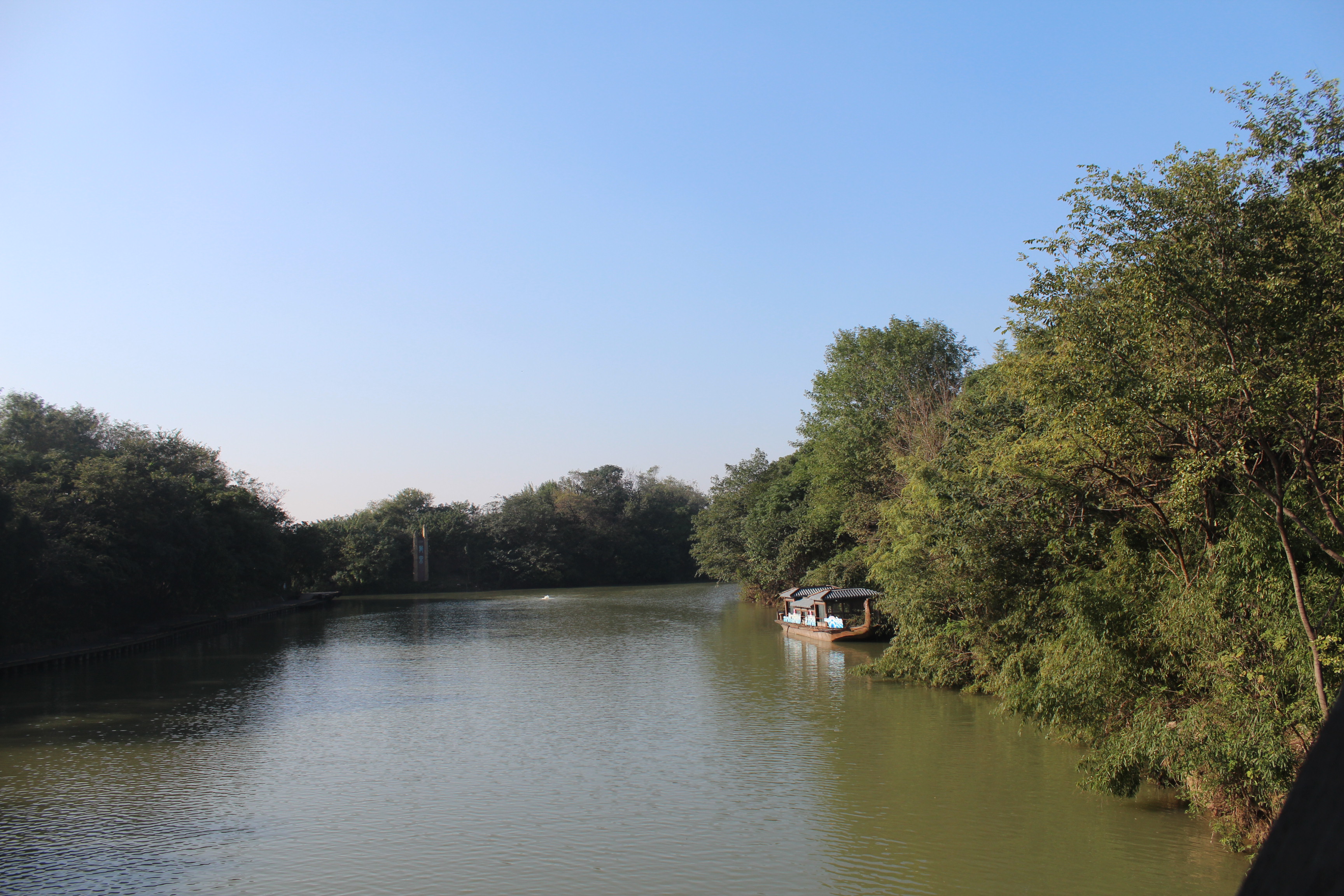
The outmost moat is the first of its kind we meet here. Hi, please look along your right hands—the high portion inside this moat is called “the outer city’s outer wall” and the left “its inner wall”.
Since the Spring and Autumn Period, China’s most scholastic schools along with their leaders had taken form. Those great ones include Confucius the forefather of education, Lu Ban the founder of carpentry, Fan Li the earliest businessman and Paoding the forerunner of cooking. Moreover, thoughts of these schools have been transmitted through many brilliant idioms to this day.
“Stealing a Ring with Covered Ears”. Once upon a time, a silly thief wanted to steal a house’s door-ring. So, he tried to break the ring with a hammer, only to get himself caught by the owner on the spot. That damned fellow is the muddle-headed thief famous from old times to now.
“A Pair of Soul Mates”. This tale tells us how Boya, a lute player in the Spring and Autumn Period, met with his soul mate. Later Feng Menglong, Ming Era’s storywriter, added Yu to Boya as a surname. Long time ago, Boya, Grand Master of Jin State, returned home by boat. When the boat got moored midway at the bank on the Mid-Autumn Night, Boya played his lute artfully amid the inviting scenery. All of a sudden, some fellow clapped his hands on the riverbank. That turned out a woodcutter called Zhong Ziqi, who made such loud noise unconsciously. The guy, attracted by the tuneful melody, told Boya candidly, there were lofty mountains and gurgling waters behind the melody. That ethereal realm went far beyond language. Hearing this remark made Boya overjoyed and thus thought the woodcutter was his unique soul mate. They made an appointment to meet again here. When Boya visited there once more, Zhong Ziqi had long passed away. So, Boya sadly threw his lute on the ground, breaking it into tiny pieces. The great musician had never played his lute since then. This sculpture brings alive a harmonious scene, in which Boya plays his lute heartily and Zhong Ziqi listens with his head leaning on one arm. Lute and mind blends into each other so as to create the so-called communion between this pair of mates.
“Making the Number”. This alludes to King Xuan of Qi State, a mad aficionado of Yu the ancient instrument. The king had 300 musicians at hand. One Mr Nanguo, knowing nothing about the instrument, joined the awesome band as if he were expert at playing it. During the playing process, he often shook his head like others. He behaved like that for three years. Later when King Xuan died, his son, Min King, loved solos instead. Consequently, Nanguo had no choice but to flee on that night with fright. He is the famous Nanguo in history. Just take a look—now he is still increasing the number here!
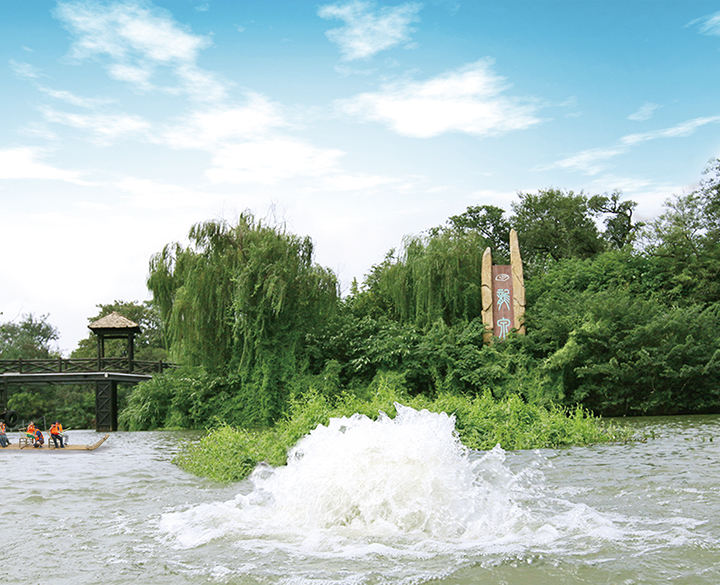
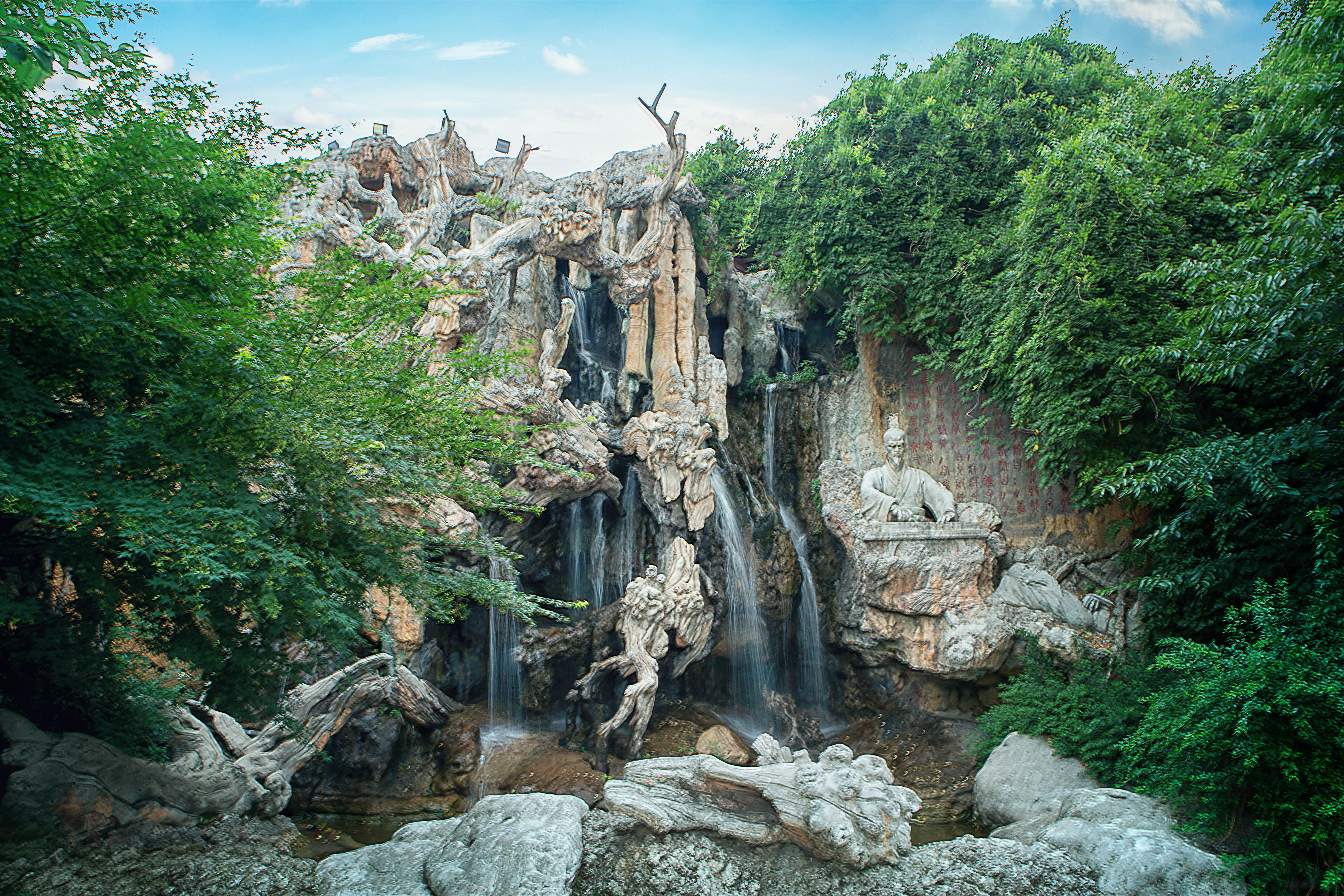
The place with foaming water, not far from here, is Dragon Spring, also called Dragon Pool. The pristine pool is infinitely deep. Local villagers ever fathomed it with a pole as long as a dozen or so meters, but still failed to touch the bottom despite all their effort. As a drought descended upon Southern China in 1934, Changwu Area (Changzhou along with its Wujin District) suffered so much that myriad rivers went dry and 1,000 mu or more fields cracked open. Instead, the spring water here looked as crystal as usual, but even gurgled endlessly. So, legend says the pool must be connected with the Dragon Palace of the Eastern Sea. As a local ballad puts, “O Dragon Spring rises from the East Sea far away; it tastes sweet and fresh over so many centuries. Like a mother, the spring nourishes all creatures on both sides. All this is ascribed to the Dragon Maiden’s White Jade Turtle.”
“Yin and Yang”, making their debut in I Ching, interpret the provenance of all things including the universe at large. The notion of “Five Phases”, consisting of Metal, Wood, Water, Fire and Earth, sprang into form in The Book of History. The two concepts had not begun to converge until the Warring States Period. This is the origin of Naturalists i.e. the School of Yin and Yang and Five Phases.
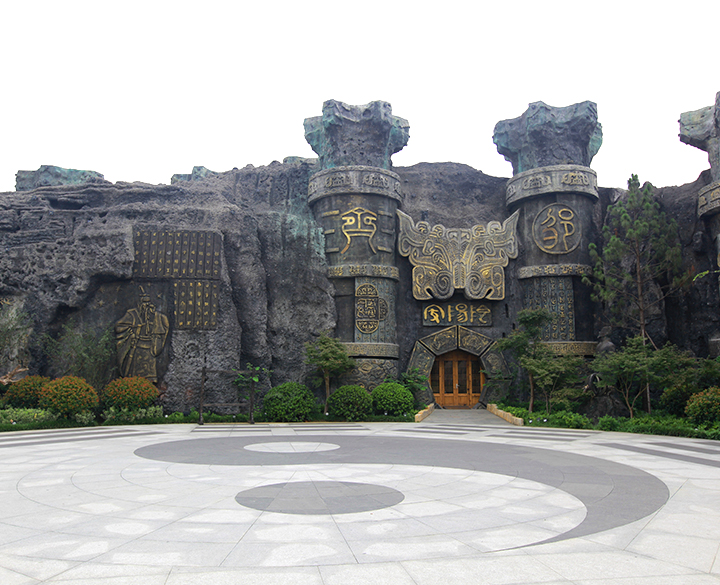
This scenic spot, set in a giant black aerolite, epitomizes what yin and yang really mean through Seven Stars of the Big Dipper, Eight Trigrams, etc. The man looking up the sky, in front of the rock, is Zou Yan, a native of Qi State, who is well-known as the best embodiment of Naturalism. Erudite as he was, the grandmaster expounded the cosmic evolution and rise and fall of dynasties applying the doctrine of Five Phases and Yin and Yang. So, he has been called “Yan Talking Celestial Phenomena” as a notable of Jixia Academy. This academy was the earliest institution of higher education and primordial science. According to some scholars, it appeared merely 20 years later than world-famous Plato’s Academy. Legend says, to promulgate his doctrines, Zou Yan toured various countries, being revered by all kings. When he arrived in Yan State in the north, the king in person swept the road for Zou Yan and took him as his own mater. Even sages like Confucius and Mencius had never enjoyed such honour. Obviously, his theory gained overwhelming prevalence during that period.