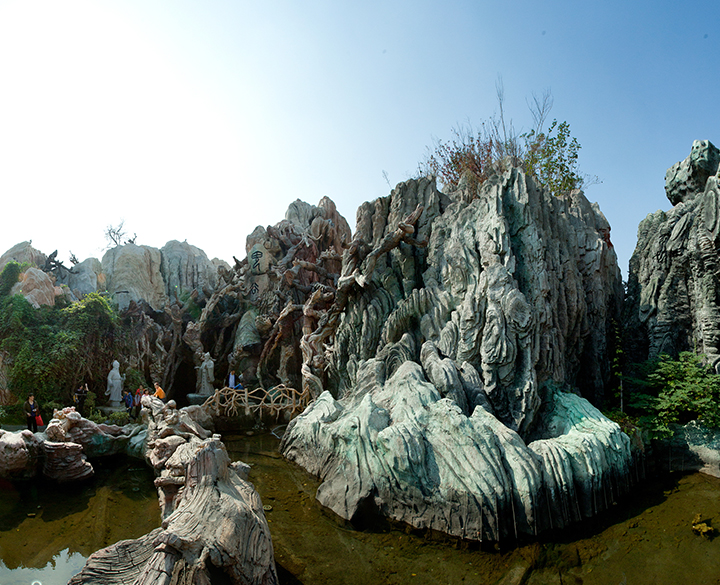
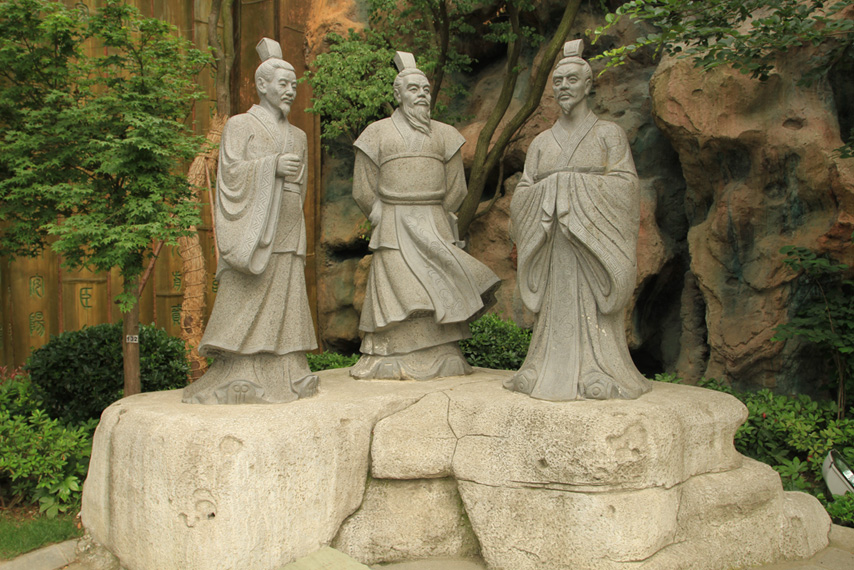
This school points to politicians and diplomats in Warring States Period. The school mainly falls into two factions: Vertical Alliance and Horizontal Collaboration. The old man standing on the cave-mouth is Guiguzi, the forefather of this overawing school. The master had an outstanding command of astrology, geography, stratagems, martial arts, unique numerological arts and eight trigrams. He wrote a masterpiece consisting of 14 chapters, called Guiguzi. The master even established “Military Academy of Warring States”. He has been venerated as the Old Patriarch of Wang Chan. Indeed, he was a grandmaster of many ways.
Guiguzi boasted of having 500 disciples, including those political, diplomatic and military personages like Su Qin, Zhang Yi, Sun Bin and Pang Juan. All these had almost made history or influenced the states they each served. It is alleged many other heroes such as Mao Sui, Xu Fu, Gan Mao, Yue Yi, Fan Ju and Zou Ji all took him as their master.
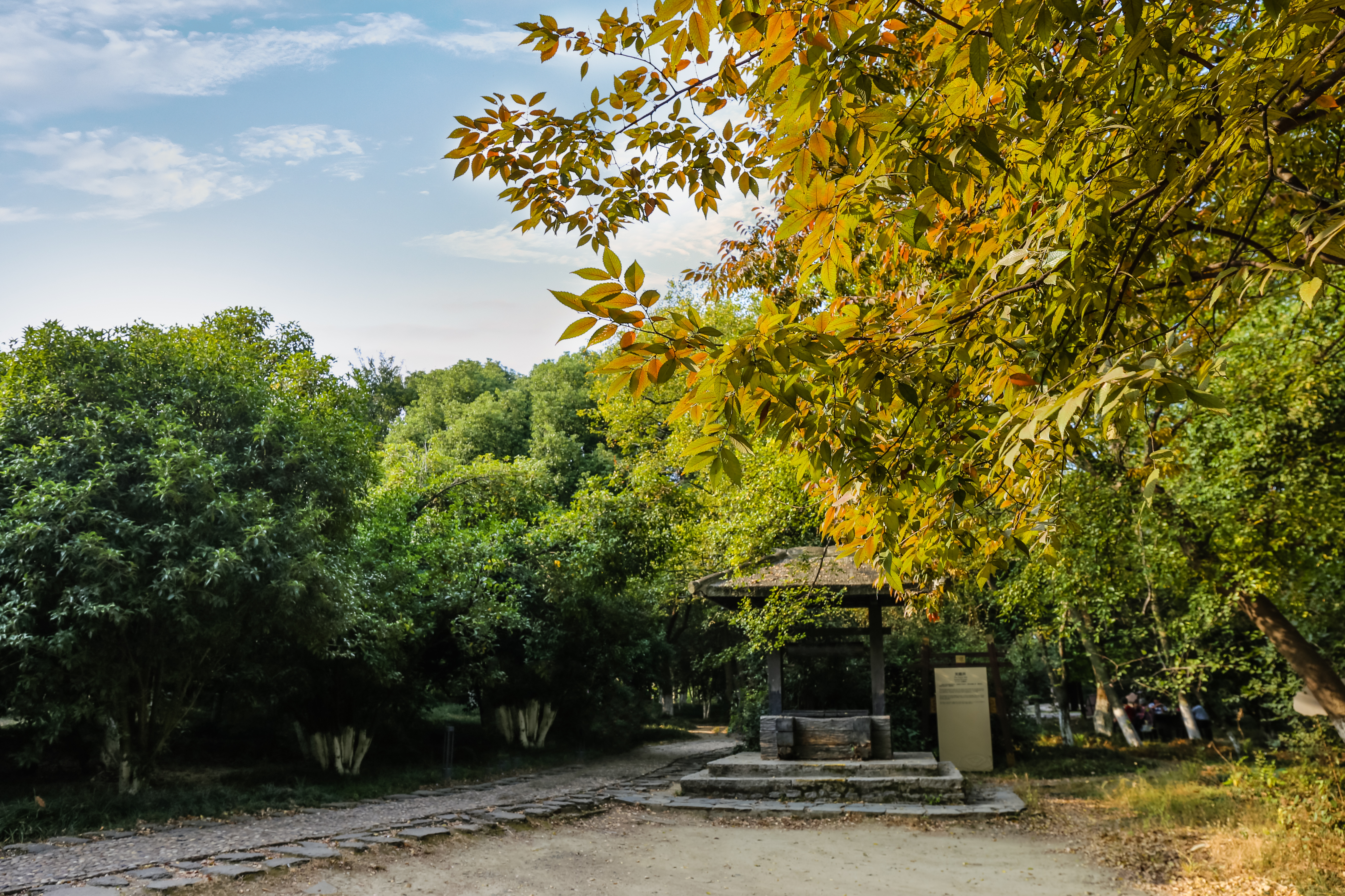
Now feast our eyes are three tall mounds: Head, Belly and Feet in order. In 1991, archaeologists excavated the head mound, thus discovering the owner’s coffin and nearly 300 burial artifacts. The tomb nestles in the outer city, which reveals its special connection with age-old Yancheng. Put it another way, the deceased should belong to the aristocracy at that time. It is noteworthy that the burial objects include some ornaments and tools like pottery spinning wheels and strings of jade pearls. So, the owner should be a female. Legend says she was one of three daughters of Yan State’s Lord, whose tombs were the mounds mentioned above. Long long ago, the Lord had a kind-hearted daughter called Princess Lark. The gorgeous maiden was the apple of the royal couple. This girl fell into love with lute, chess, calligraphy and painting. Again, she sang and danced with great finesse. Above all, the much-gifted princess was diligent and beautiful. Liucheng nearby had an ambitious prince, who became the Lord Yan’s son-in-law using dishonest means. When the Lord went out one day, the hideous prince got the key to the backyard garden in the name of his wife and stole away White Jade Turtle—the treasure of Yan State. As soon as he knew the news, the Lord got furious and executed his beloved Princess Lark. Later he made clear the truth and felt full of remorse. He buried his lovely daughter once more. This is the origin of the three mounds still alive on the lips of locals.
Inside and outside Yancheng, there were once hundreds of mounds, of which Stone Grinder Mound occupied 90 mu, the largest of all. These were believed to have relations with the city defense. In 1987, archaeologists excavated Ganjia Mound, from which more than 40 potteries and celadons as well as remaining bones have ever since seen the light of day. This discovery has further proved that these mounds are all ancient tombs.
This miscellaneous school, first appearing in Warring States Epoch, integrated the strengths of all other schools. Its initiator was Lü Buwei. The writing on the giant bamboo scroll is a part of Lü Clan’s Spring and Autumn Annals, a magnum opus in this regard. This grand academic work is really an ancient encyclopedia that came out through nearly a decade’s effort of Lü himself and many talents under his aegis. It offers an important guide to studying the pre-Qin history, culture, politics and economy. The advent of such miscellany demonstrated all thought schools had converged to a certain extent.
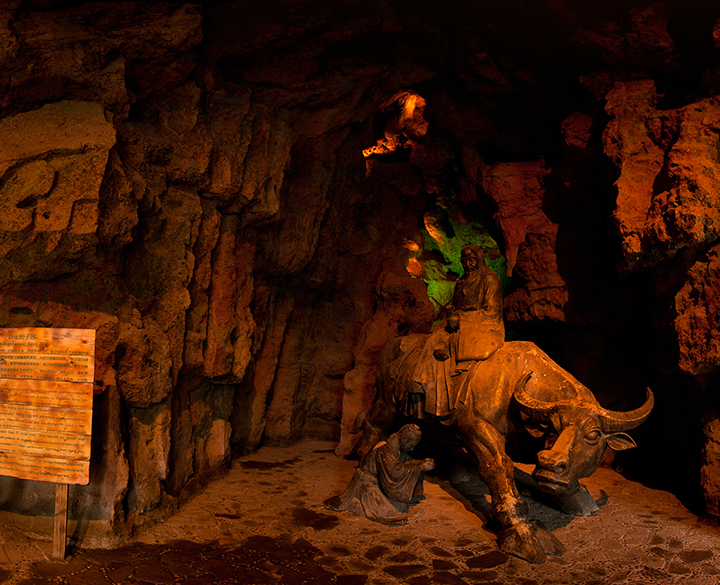
Legend says Laozi the grandmaster established this school. All its followers argued “the way of following nature” and “the importance of doing nothing”. In particular, Laozi himself and Zhuangzi separately composed Tao Te Ching: The Way and its Virtues and Zhuangzi: Wandering of the Way.
Laozi, also called Laodan, has been revered as the “Old One”. It is said this master later headed west on a black ox. Hangu Pass’s guard-in-chief Yin Xi, on the Sky-Watching Pavilion, suddenly saw a purple vapour rising in the east. He said to his underlings a sage must be coming here soon. As he had said, Laozi on an ox arrived slowly within 3 days. Yin Xi asked the master to leave him some words, otherwise he would not allow him to take leave. Then Laozi the Lord wrote Tao Te Ching, a short book of 5,000 characters influencing later China and the world at large.
Yancheng’s inner city sprawls 1,500 meters, about 3 li (a Chinese unit of length, 1 li=500 meters) while the outer city stretches 3,500 m or 7 li. Their areas fit well in with the relevant account in Mencius. Besides, the urban design has its own unique mystery. In a bird’s-eye view, the entire relic site looks quite like the Eight Trigrams according to Taoism and Geomancy. It is said the outmost moat had eight brooks and four watergates at the earliest time. Hong Kong based geomancer Mai Rongyao, having investigated the site, concluded the eight brooks represent eight trigrams in I Ching. The construction time shows Yancheng was the earliest city in the world to follow the mysterious geomancy. So, it is also called “First City of Chinese Fengshui”.