分类: 景区动态

  • 10.Bamboo Well

    10.Bamboo Well


    Bamboo Well is located in the Imperial City of Yancheng, with a history of about 3,000 years. The well is about 7 meters deep with square wellhead. Four corners of well are fixed with logs with a diameter of 10 cm. Thin bamboo is woven around the well wall to strengthen the well wall and filter the well water.

    Such unique well is called “Bamboo Well”, as one of the early water well styles in China, mostly found in southern plain. Archaeologists found a pottery pot at the bottom of the well testified to be a tool used for fetching water, which proved that humans have settled here for a long time.

  • 14.Confucianism

    14.Confucianism


    Confucianism pervaded more 2,000 years of feudal China. Since Emperor Wu of Han prioritized Confucianism before all others, the school represented by Confucius, Mencius and Xunzi had gradually become the mainstream thought permeating traditional Chinese culture.

    Confucius, the founder of Confucianism, claimed a state shall be governed through ritual and virtue. He initiated private education, thus being reputed as the forerunner of plebeian education. History records “The Confucian master has 3,000 disciples, including 72 sages”. The Analects of Confucius has venerated as one of classics of Chinese thought and culture.

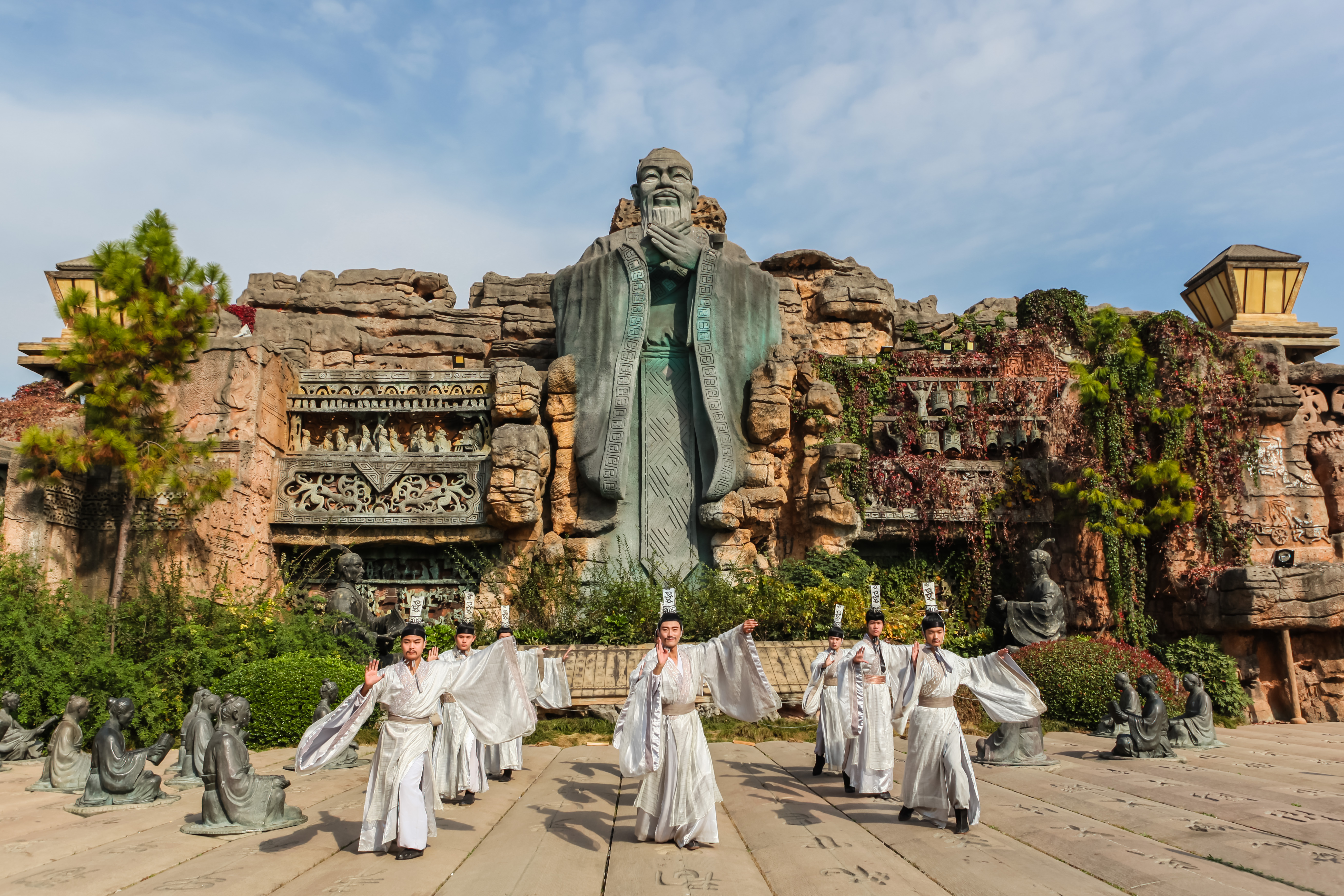
    The statue of Confucius standing on the slope is 17 meters’ tall. The master, leaning forward with both hands clasped together, appears an amiable old man indeed. This image embodies Confucianism’s five virtues: moderation, kindness, respectfulness, frugalness and modesty. The stone inscription on the hill surface tells us what Confucius had undergone through his lifetime. Below this master are located statues of two junior sages—Mencius and Xunzi.

  • 13.兵家

    13.兵家


    春秋战国时期,烽火连天、战事频发。兵家的代表人物有春秋时期的孙武、司马穰苴,战国时的吴起、孙膑等。其中孙武被后人尊称为“兵学鼻祖”、兵圣,所著《孙子兵法》是世界上最古老的军事理论著作,对后世影响深远,被誉为“兵学圣典”。

  • 15.Legalism

    15.Legalism


    Typical Legalist Hanfeizi argued the state shall be ruled through stern punishment and strict legislation. Hanfeizi, vintage work of the thinker, has influenced ancient and modern China. This school created a profound impact on Chinese history.

  • 14.儒家

    14.儒家


    儒家文化贯穿了中国2000多年的历史,自汉武帝罢黜百家,独尊儒术开始,以孔子、孟子、荀子为代表的儒家思想,逐渐成为中国传统文化的主流。

    孔子是儒家学派的创始人,主张以礼乐治国,以德治国。他首创私学,开创了平民教育的先驱,史传说“门徒三千,贤者七十二”;而记录了孔子及其弟子言行的《论语》,则是中国思想文化最重要的经典之一。

    儒家区域依托山势的孔子塑像,这尊雕像高17米,孔子双手作揖,身体微向前倾,为温厚长者的形象,体现了孔子“温、良、恭、俭、让”。山体上的石雕文字,讲述了孔子生平经历,孔子塑像下一左一右坐着的名别是儒家的另外两个代表人物孟子和荀子。

  • 16.Minor-Talk School

    16.Minor-Talk School


    “Minor-Talk” originated from Zhuangzi. As said in “Records of Literature and Art”, The Book of Han Dynasty, “The school of minor talks is derived from minor officials who loved talking about anecdotes. It is about gossips, chats and suchlike.” Such minor officials mainly took charge of recording what the plebs talked about, namely legends. Yu Chu in Western Han Epoch was known as one of paragons of this school. Yu created An Anthology of Stories on Zhou Era, the first collection of stories ever in ancient China.

  • 15.法家

    15.法家


    法家的代表人物韩非子,他主张以严刑峻法治国,代表作品《韩非子》。法家学说对于整个中国历史影响深远。

  • 17.Logicism

    17.Logicism


    What followers of this school talk is the name and essence of things, rights and wrongs of cases. In fact, it was the school of logic in ancient times, which boasts typical figures like Gongsun Long, Deng Xi and Hui Shi. Such logicians were famous for being expert at analyzing the “name” and the “essence”. Up till now, their classic dogmas like “White Horse Is not a Horse at All” have been still alive.


  • 16.小说家

    16.小说家


    “小说”之名,出于庄子。《汉书·艺文志》中关于小说家的论述:“小说家者流,盖出于稗官;街谈巷语,道听途说者之所造也。”稗官主要负责在民间记录百姓所谈论的内容,也就是野史。称为小说家的是西汉的虞初,他创作中国古代第一部小说——《周说》。

  • 18.Marketplace Commercial Street

    18.Marketplace Commercial Street


    Marketplace Commercial Street reproduces prosperity of thirty-six elements including ancient folk acrobatics, Quyi, hawking and divination, as well as people shopping in the city, with ancient architecture in antique style and strong Chinese traditional flavor, combined with copper plastic landscaping and literary roadshows.

    Commodities sold in Marketplace Commercial Street are mainly handicrafts with local characteristics of Changzhou. It is also a centralized exhibition area for intangible cultural heritage projects in the park.

    There are three memorial archways from the Qing Dynasty in Marketplace Commercial Street, namely, Zhongyi (loyalty and righteousness) archway from the reign of Qianlong, Jiexiao (sparing and filial piety) archway from the reign of Guangxu, and Gongde (merit) archway from the reign of Xianfeng. The three archways have sublime but simple shapes and exquisite stone carvings, bearing high artistic value. They are also meaningful attempts to carry out cultural relics protection in different places in Yancheng Tourism Area.