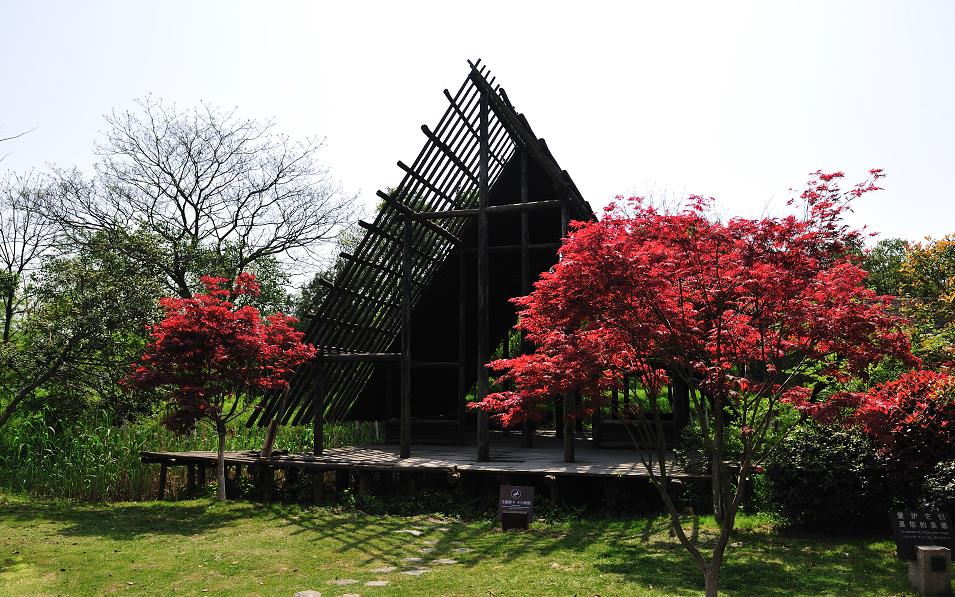
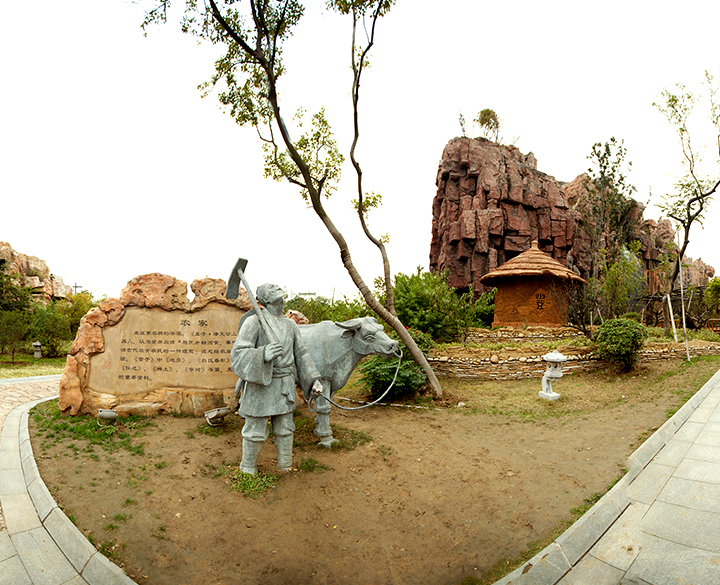
What pleases the eye to the left is a row of rustic dwellings, which imitate the ancient cottages of the Spring and Autumn Epoch. Owing to the heavy rainfall here, these folk houses, in fact wood structures, had deteriorated with great speed. Within the relics park, there is therefore no such dwelling unscathed till now. What stand the test of time are simply the cities along with moats and numerous antiquities excavated all these years.
In ancient China, this school points to doctors, in particular famous ones like Eastern Han’s Zhang Zhongjing and Hua Tuo, Tang’s Sun Simiao the King of Medicine. Bian Que in the Spring and Autumn Period stood out of these doctors through the ages. Qin Yueren was called Bianque because his superb medicine, in the hearts of the people, matched well the magical doctor in the primeval past.
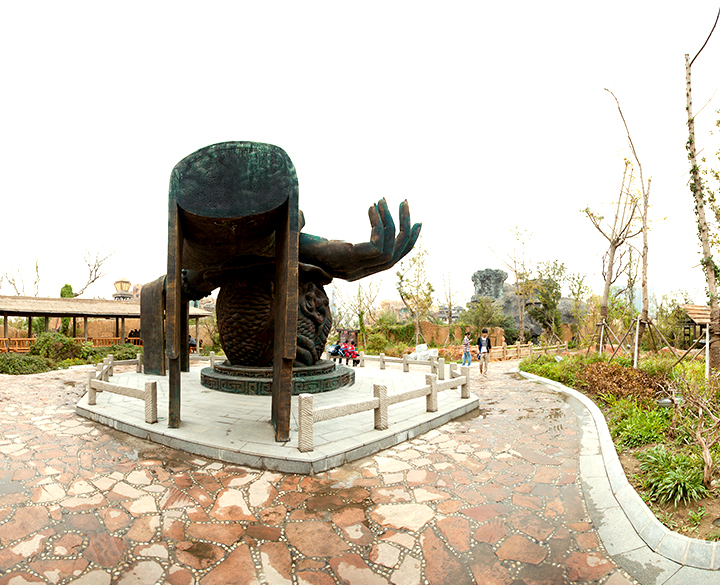
The sculpture in the center of the square shows how the wondrous doctor took his patient’s pulse. According to The Book of the Grand Historian, Bianque first applied pulse-based diagnosis in clinical treatment. The forefather of Chinese medicine was the first of his kind officially recorded in history. He initiated four diagnostic methods: watching, smelling, asking and pulse-taking. Such tremendous contributions have earned him a niche in history.
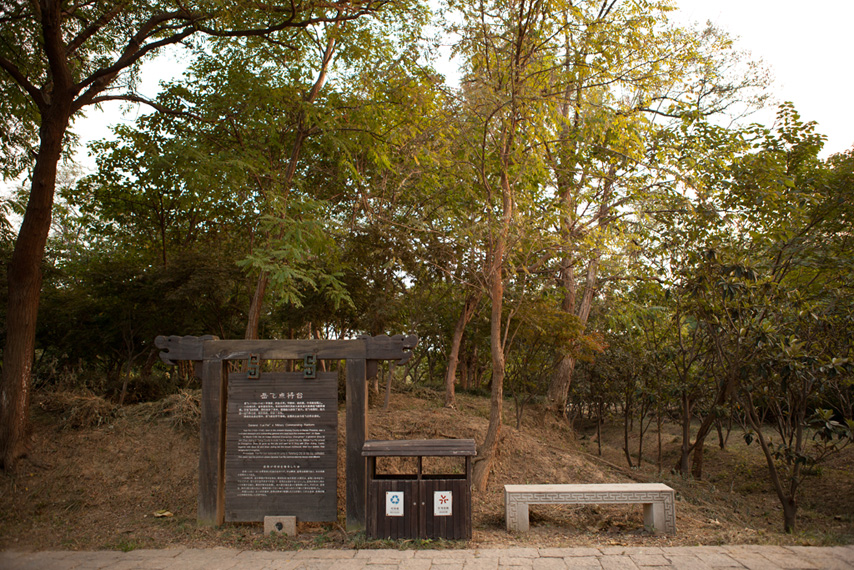
What we can see in the front left-hand side is the relic site where Yue Fei, a generalissimo of the Southern Song, ever appointed major generals. When Jurchen army invaded the frontier during Jianyan Period, the generalissimo along with his troops was stationed here to fight the enemies.
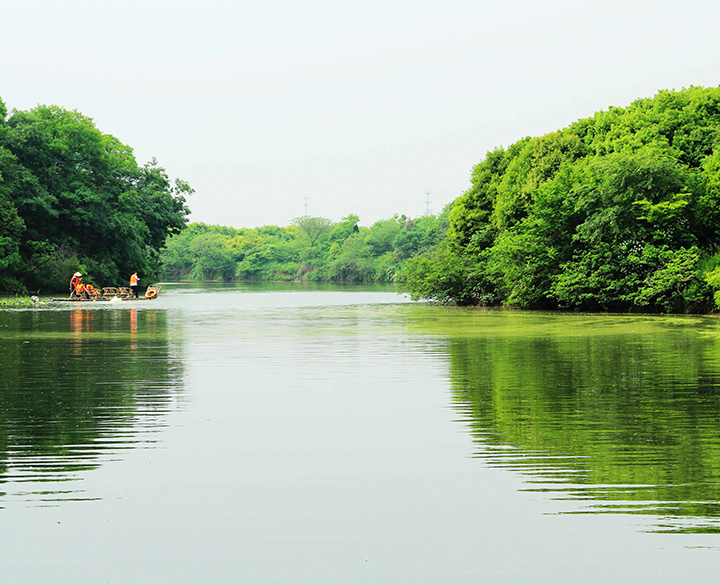
Now we can see the second moat of age-old Yancheng. The moat is 4 m deep on the average, but may be a dozen meters or so deep as well. The width, normally 30-50 meters, may be 60 meters at most. There have been 4 canoes unearthed from the moat thus far. The 11 meter-long canoe now belongs to the National Museum of China and the 4.2 meter-long lies in Nanjing Museum. The remaining two have been collected in Wujin District Yancheng Museum. Researchers had dated the old-time canoes using the carbon-14 isotope. In particular, the canoe as long as 7.45 meters has been 2800 years old. The oldest and best-preserved boat discovered ever in China has been dubbed the “First Boat under the Sun”.
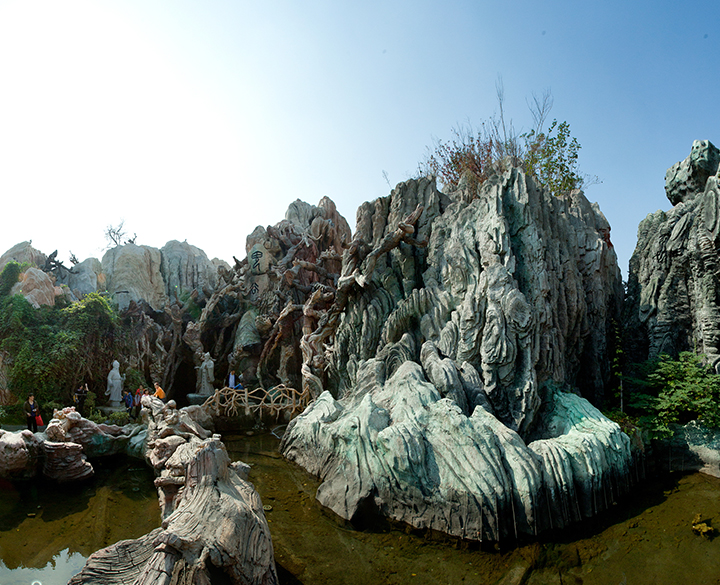
This school points to politicians and diplomats in Warring States Period. The school mainly falls into two factions: Vertical Alliance and Horizontal Collaboration. The old man standing on the cave-mouth is Guiguzi, the forefather of this overawing school. The master had an outstanding command of astrology, geography, stratagems, martial arts, unique numerological arts and eight trigrams. He wrote a masterpiece consisting of 14 chapters, called Guiguzi. The master even established “Military Academy of Warring States”. He has been venerated as the Old Patriarch of Wang Chan. Indeed, he was a grandmaster of many ways.
Guiguzi boasted of having 500 disciples, including those political, diplomatic and military personages like Su Qin, Zhang Yi, Sun Bin and Pang Juan. All these had almost made history or influenced the states they each served. It is alleged many other heroes such as Mao Sui, Xu Fu, Gan Mao, Yue Yi, Fan Ju and Zou Ji all took him as their master.
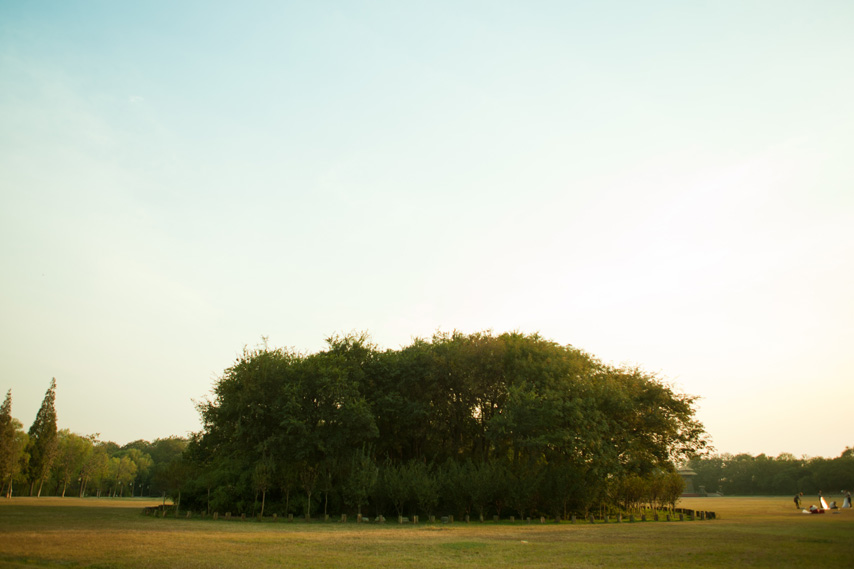
Now feast our eyes are three tall mounds: Head, Belly and Feet in order. In 1991, archaeologists excavated the head mound, thus discovering the owner’s coffin and nearly 300 burial artifacts. The tomb nestles in the outer city, which reveals its special connection with age-old Yancheng. Put it another way, the deceased should belong to the aristocracy at that time. It is noteworthy that the burial objects include some ornaments and tools like pottery spinning wheels and strings of jade pearls. So, the owner should be a female. Legend says she was one of three daughters of Yan State’s Lord, whose tombs were the mounds mentioned above. Long long ago, the Lord had a kind-hearted daughter called Princess Lark. The gorgeous maiden was the apple of the royal couple. This girl fell into love with lute, chess, calligraphy and painting. Again, she sang and danced with great finesse. Above all, the much-gifted princess was diligent and beautiful. Liucheng nearby had an ambitious prince, who became the Lord Yan’s son-in-law using dishonest means. When the Lord went out one day, the hideous prince got the key to the backyard garden in the name of his wife and stole away White Jade Turtle—the treasure of Yan State. As soon as he knew the news, the Lord got furious and executed his beloved Princess Lark. Later he made clear the truth and felt full of remorse. He buried his lovely daughter once more. This is the origin of the three mounds still alive on the lips of locals.
Inside and outside Yancheng, there were once hundreds of mounds, of which Stone Grinder Mound occupied 90 mu, the largest of all. These were believed to have relations with the city defense. In 1987, archaeologists excavated Ganjia Mound, from which more than 40 potteries and celadons as well as remaining bones have ever since seen the light of day. This discovery has further proved that these mounds are all ancient tombs.